
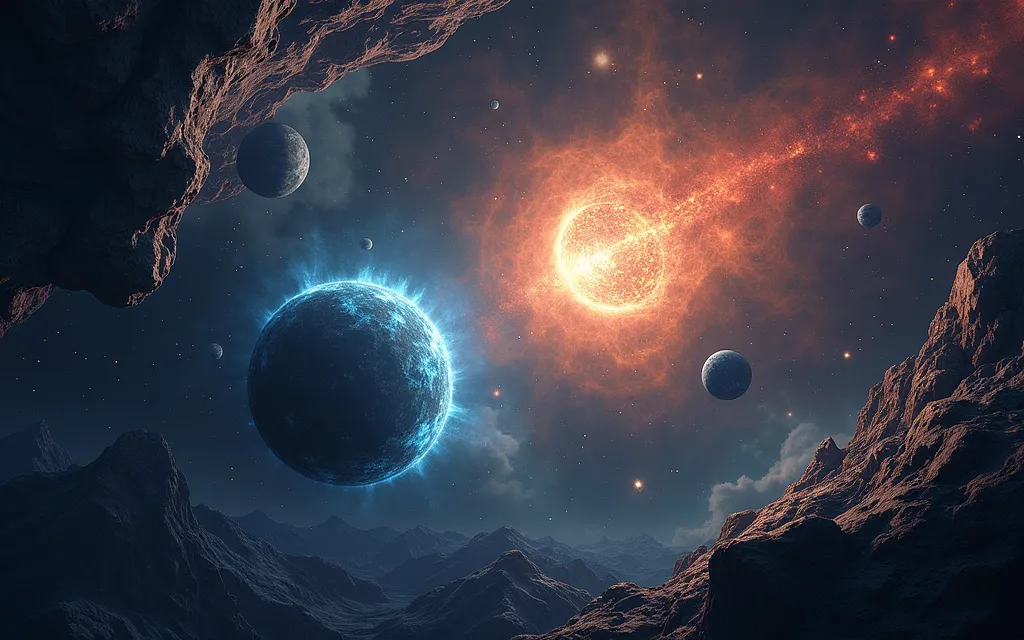
In the vast expanse of the cosmos, our understanding of life remains tethered to the familiar conditions of our Earth – sunlight, water, and a carbon-based biology. But what if life, in its boundless creativity, has taken forms far beyond our current comprehension? What if existence flourishes in environments utterly alien to our own, sculpted by forces we are only beginning to grasp? This article embarks on an exploration of such possibilities, delving into the realm of Crystalloids and Magnetars – beings and celestial entities that challenge our very definition of life and the universe’s potential for diversity.
Before we delve into the specifics of Crystalloids and Magnetars, it’s crucial to address a fundamental point: the nature of knowledge and evidence. As the text poignantly states, “If you ask me for proof of the existence of Crystalloids, I don’t even have proof of the existence of humans yet.” This highlights a crucial distinction between empirical, demonstrable proof and the exploration of possibilities, especially in realms that push the boundaries of our current scientific understanding. The pursuit of knowledge, particularly in cosmology and the nature of life, often involves venturing beyond the strictly measurable and embracing intuition, theoretical frameworks, and open-minded inquiry.
The text emphasizes a journey of discovery, “We are looking for truth, and seeking to explore God’s universe and what happens as intuitive perceptions for loved ones.” This underscores a spirit of humility and open exploration, acknowledging the limitations of current human knowledge and embracing the potential of intuitive insights to guide our understanding. It is a journey driven by curiosity and a desire to unravel the mysteries of existence, rather than a rigid adherence to established dogma.
The text anticipates a future where the boundaries of science expand to encompass what is currently considered esoteric or purely intuitive knowledge. “In the near future, all that is intuition will lead to vision, meaning all that was not science one day, like the entire length of history, science will soon open windows to it, and these topics will be made public.” This suggests a coming paradigm shift, where the insights of mystics, intuitives, and ancient wisdom traditions will find resonance and validation within the framework of scientific inquiry. The exploration of Crystalloids and Magnetars, therefore, is presented as a step towards this expanded understanding of reality.
The Stellar Life Cycle: From Nebulae to Neutron Stars and Magnetars
To understand the context of Crystalloid life, we must first journey into the realm of stellar evolution, the cosmic dance of birth, life, and death of stars. The text provides a concise yet illuminating overview of this cycle, starting with nebulae, vast clouds of interstellar gas and dust, often referred to as “stellar dust.”
Nebulae are the cosmic nurseries where stars are born. These clouds, composed primarily of hydrogen and helium, are not uniform but possess regions of higher density and gravitational pull. These “points of attraction” in the fabric of space-time act as cosmic magnets, drawing in surrounding stellar dust and gas. As more material accumulates, gravity intensifies, and the nebula begins to collapse in on itself. This gravitational compression heats the core of the collapsing cloud, eventually igniting nuclear fusion – the birth of a star.
Over vast stretches of time, stars undergo various stages of evolution. A star like our Sun will eventually exhaust its core hydrogen fuel, causing it to expand dramatically into a red giant. Following this phase, it will shed its outer layers, forming a planetary nebula, leaving behind a dense, hot core known as a white dwarf. However, stars significantly more massive than our Sun face a more dramatic and energetic fate – the supernova.
Supernovae are cataclysmic stellar explosions, marking the death throes of massive stars. When these stars exhaust their nuclear fuel, their cores collapse under their own immense gravity, triggering a runaway fusion reaction that blasts the star’s outer layers into space in a spectacular display of cosmic fireworks. The aftermath of a supernova is not destruction but transformation. Depending on the initial mass of the star, a supernova can leave behind one of three exotic remnants: a white dwarf, a neutron star, or a black hole.
The text highlights the cyclical nature of this stellar life cycle, echoing the poetic sentiment, “Who was diminished by dying…”. This line suggests that stellar death is not an end but a transition, a recycling of cosmic material that fuels the birth of new stars and potentially new forms of life. Supernovae, in this view, are not just cosmic explosions but also cosmic seeds, scattering elements forged in stellar furnaces across the universe, enriching the interstellar medium for future generations of stars and planets.
Neutron Stars and Magnetars: Extreme Environments, Extreme Life?
The text focuses specifically on neutron stars and magnetars, two of the most extreme and enigmatic objects in the universe, as potential abodes for Crystalloid life. Neutron stars are formed from the collapsed cores of massive stars after supernovae. The gravitational collapse is so intense that protons and electrons are crushed together to form neutrons, creating an incredibly dense object – a stellar remnant packed with the mass of the Sun into a sphere only a few kilometers in diameter.
Magnetars are a विशेष type of neutron star, distinguished by their extraordinarily powerful magnetic fields – the strongest magnetic fields known in the universe, trillions of times stronger than Earth’s magnetic field. These intense magnetic fields are generated by the rapid rotation and convection within the neutron star’s interior. Magnetars are known to emit bursts of high-energy electromagnetic radiation, including X-rays and gamma rays.
The text draws a fascinating parallel between black holes and white holes, invoking the concept of quantum entanglement and Schrödinger’s cat paradox. It suggests that black holes and white holes might be interconnected, forming a cosmic wormhole or a gateway between different regions of space-time. While this remains a theoretical and highly speculative concept, it underscores the text’s inclination to explore unconventional and mind-bending possibilities within the universe.
Crystalloid Beings: Life Based on Crystal, Light, and Gravity
Amidst this cosmic drama of stellar birth and death, the text introduces the concept of Crystalloid beings – life forms adapted to the extreme environments surrounding neutron stars and magnetars. These beings, unlike carbon-based life on Earth, are described as being “crystal-based,” their biology fundamentally different from our own.
The text emphasizes the diversity of creation, “God’s creations are countless, and these have different categories: categories of air-essence, water-essence, fire-essence, earth-essence, as well as elements that are not yet recorded in the periodic table.” This highlights the vast spectrum of potential life forms that may exist in the universe, beyond the limited scope of our current scientific understanding. Crystalloids are presented as one such category, beings whose very essence is intertwined with the unique conditions of neutron star environments.
Physical Characteristics and Appearance
Crystalloids are described as having a “glass-colored” or “crystal-colored” appearance, suggesting a translucent or crystalline structure. They are said to possess a humanoid form, sharing general features with humans, but with notable differences: “their waist is thinner than ours, their shoulders are a little wider.” This description paints a picture of beings that are both familiar and alien, humanoid in overall shape yet composed of fundamentally different materials and proportions.
Their bodies are described as being composed of “crystalloid material,” formed in the vicinity of neutron stars. Their life force is sustained by “crystal, light, and gravity,” drawing energy and sustenance from these fundamental forces prevalent in their extreme environment. Just as plants on Earth utilize sunlight for photosynthesis, Crystalloids are proposed to utilize the intense gravity and electromagnetic radiation of magnetars as their primary energy source.
A Civilization Forged in Extreme Conditions
The text paints a picture of a thriving ecosystem around magnetars, with “crystal-colored plants (glass-colored),” “crystal-colored animals (crystal),” and “intelligent crystalloid beings” inhabiting planets within the habitable zones of these stellar remnants. This suggests a complete and self-sustaining biosphere, adapted to conditions that would be lethal to carbon-based life as we know it. The habitable zone around a magnetar, however, is not defined by sunlight but by the intense gravitational and electromagnetic forces emanating from it.
The concept of a “habitable zone” is broadened beyond the conventional notion of a region around a star where liquid water can exist on a planet’s surface. In the context of magnetars, the habitable zone is defined as a region where the gravitational and electromagnetic forces are conducive to Crystalloid life. This highlights the adaptability of life and the potential for diverse forms of existence to arise in a wide range of cosmic environments.
Reproduction and Diet: Alien Biology
The text offers intriguing glimpses into Crystalloid biology, describing their reproduction and diet as fundamentally different from humans. Their reproductive process is described as an “energetic transfer” rather than a physical union in the human sense. “The male partner takes the female partner’s hands, presses his stomach to the woman’s stomach, stands opposite, and kisses each other, and that issue that exists in humans does not exist in them.” This suggests a more ethereal and energy-based form of reproduction, where physical contact serves as a catalyst for energetic exchange and the initiation of new life.
Crystalloids are described as primarily “herbivorous,” consuming “crystal plants” that are cultivated on their planets and are themselves based on the neutron star’s energy. This reinforces the idea of a crystal-based ecosystem, where both flora and fauna are adapted to utilize the unique energy sources of their environment. Their diet, therefore, is as alien to us as their physiology and their stellar abode.
Advanced Civilization and Interstellar Travel
The text alludes to the advanced nature of Crystalloid civilization, stating that they possess a “much older civilization than humans.” This seniority is implied to translate into a more “humane and transcendent” set of societal laws and values. Crystalloids are depicted as viewing human civilization on Earth as “very base, very difficult, and extremely polluted,” considering humanity to be “Stone Age, barbaric, and primitive” in comparison to their own technological and societal advancements.
The text also touches upon the immense distances separating Earth from magnetars and neutron stars, emphasizing that interstellar travel to these regions would require “years of travel.” However, it also hints at advanced technologies, such as the potential to “break and bend space-time” using “electromagnetics,” suggesting that interstellar travel, while challenging, may be achievable through breakthroughs in physics and engineering. This alludes to the possibility of advanced civilizations, like the Crystalloids, possessing technologies that transcend our current understanding of space and time.
Neutron Stars in Ancient Texts: Echoes of Cosmic Wisdom
Intriguingly, the text connects neutron stars and magnetars to ancient religious and spiritual texts, suggesting that these celestial objects may have been recognized and revered in ancient wisdom traditions. “Our pulsar star in the Quran and the Bible and many books about neutron stars is the same pulsating star that has been spoken of.” The Quranic verse “By the sky and the Night-Visitant (At-Tariq)” is cited as a possible reference to a neutron star, with “At-Tariq” (the Night-Visitant) being interpreted as a “neutron star, which is mentioned in the Quran.”
References to neutron stars are also suggested to exist in the Bible and the Vedas, portraying these celestial bodies as “major influences in the universe.” This connection to ancient texts adds a layer of mystique and suggests that knowledge of neutron stars and their potential significance may not be entirely new but rather echoes through human history, encoded in ancient scriptures and esoteric traditions. Whether these interpretations are literal or metaphorical remains open to debate, but they highlight the enduring human fascination with the cosmos and the search for meaning beyond our earthly realm.
Pulsars and Magnetars: Distinctions within Neutron Stars
The text clarifies the distinction between pulsars and magnetars, both being types of neutron stars. Pulsars are described as “rotating neutron stars that rotate at high speed.” From Earth, they appear to “blink like twinkling stars” due to their rapid rotation and the emission of narrow beams of radiation. However, the text clarifies that “pulsar light does not actually fluctuate and flicker,” but rather the blinking effect is an illusion created by their rotation and beam emission.
Magnetars, on the other hand, are distinguished by their “very strong magnetic field (electromagnetic gravity).” This intense magnetic field is the defining characteristic that differentiates them from other neutron stars, including pulsars. Magnetars are known for emitting powerful bursts of electromagnetic radiation, particularly X-rays and gamma rays, making them among the most energetic objects in the universe.
Pulsars, due to their rapid rotation, are described as ejecting subatomic particles, likened to “a balloon that is partially punctured and expels air.” This expulsion of particles is seen as the pulsar’s way of shedding materials that cannot be fused in its core, while the remaining material is used as “atomic fuel” for fusion processes. Both magnetars and pulsars are described as sites of nuclear fusion, the energy source that powers their extreme phenomena and, in the case of magnetars, potentially sustains Crystalloid life in their vicinity.
Crystalloid Reproduction: An Energetic Union
The text provides further details on Crystalloid reproduction, emphasizing its energetic nature and contrasting it with human biology. Crystalloid beings are described as “glass-colored” in their physical form, further reinforcing their crystalline nature. Their reproductive process, as mentioned earlier, involves a non-physical “intercourse” where the male and female partners engage in an energetic exchange, initiating the formation of a new Crystalloid being within the female’s womb.
This description challenges our anthropocentric view of reproduction, suggesting that life can propagate in ways that are fundamentally different from our own biological processes. Crystalloid reproduction, as portrayed, is a more ethereal and energy-based phenomenon, aligned with their crystalline nature and their existence in extreme environments where energy and gravity dominate.
Crystalloid Diet: Sustained by Crystal Plants
The text reiterates the herbivorous diet of Crystalloids, emphasizing their consumption of “plants that are crystalline and based on the neutron star itself” and cultivated on their planets. This reinforces the concept of a self-contained ecosystem around magnetars, where life is intricately adapted to the unique conditions of these stellar remnants. Crystalloid diet, therefore, is not based on carbon-based organic matter but rather on crystal-based flora that derive their energy directly from the magnetar’s radiation and gravitational forces.
Human Adaptation and Future Interstellar Migration
Despite the extreme differences between human and Crystalloid biology and environments, the text offers a somewhat optimistic perspective on potential future interactions. It suggests that if humanity were to migrate to a planet orbiting a magnetar, our bodies, while initially experiencing “disruptions in blood pressure and some organs and systems,” might eventually adapt to the high electromagnetic environment. “The human body has a property that adapts itself to conditions,” the text states, hinting at the remarkable plasticity and adaptability of life.
This prospect of human adaptation to magnetar environments, while speculative, opens up intriguing possibilities for the future of humanity and our potential for interstellar expansion. It suggests that our biological limitations may be more flexible than we currently assume, and that with sufficient time and adaptation, we might be able to thrive in environments that currently seem utterly inhospitable.
Crystalloid Civilization: A Glimpse into a Transcendent Future?
The text concludes by emphasizing the “extraordinarily humane and transcendent laws” governing Crystalloid civilization, attributing this to their “much older civilization than humans.” This paints a picture of a society far more advanced not just technologically but also ethically and spiritually, a civilization that has perhaps overcome many of the challenges and limitations that currently plague humanity.
The Crystalloid perspective on human life, as described in the text, serves as a mirror reflecting back our own shortcomings and potential for growth. Their perception of Earthly life as “very base, very difficult, and extremely polluted” is a stark critique of our current state, highlighting the need for greater harmony, sustainability, and ethical development. The hope expressed in the text, “I hope that one day we too will reach the conditions in which life occurs in magnetars and around them,” is a call for aspiration, for striving towards a more evolved and enlightened future, perhaps even drawing inspiration from the imagined example of Crystalloid civilization.
Conclusion: Beyond Carbon and Sunlight – Embracing Cosmic Diversity
The narrative of Crystalloids and Magnetars, while venturing into speculative and esoteric realms, serves as a powerful reminder of the boundless diversity and potential for life in the cosmos. It challenges our anthropocentric biases, urging us to expand our definitions of life and habitability beyond the narrow confines of our Earth-centric perspective. It invites us to contemplate the possibility of life forms fundamentally different from our own, thriving in environments shaped by forces far more extreme than sunlight and water.
Whether Crystalloids and Magnetars exist as described remains a matter of speculation and open inquiry. However, the very act of considering such possibilities expands our imagination and fuels our quest to understand the true nature of life and the universe. The exploration of these enigmatic beings, therefore, is not just about seeking empirical proof but about embracing the wonder, mystery, and boundless potential of creation, acknowledging that the universe may hold far more wonders than we have yet begun to imagine.